
Courts and lawyers
Taking your case to the Supreme Court? How to choose your advocate
इस लेख को हिन्दी में पढ़ें
In short
To take a case to the Supreme Court, you need an Advocate-on-Record (AOR). Only an AOR can file your case and act for you on the Court's record. A Senior Advocate can argue your case, but only alongside your AOR, and you engage one through your AOR, never directly. Before you sign a vakalatnama, the document that authorises an advocate to act for you, check 3 things: that the advocate is on the Court's current list of AORs, that they have appeared recently in Supreme Court cases like yours, and what the fee covers, in writing. The rules protect you too: the fee cannot be a share of what the case brings you, your papers stay yours, and you can change your AOR in the middle of a case.
Who does what in a Supreme Court case
The advocate who files your case may not be the one who argues it. Order IV of the Supreme Court Rules, 2013 sets out the roles.
| Role | Can they file your case? | Can they argue it? | Can you engage them directly? |
|---|---|---|---|
| Advocate-on-Record (AOR) | Yes. They act for you on the Court's record. | Yes | Yes |
| Senior Advocate | No | Yes, but only with an AOR | No. Your AOR briefs them. |
| Any other advocate | No | Yes, when your AOR instructs them or the Court allows it | Yes, but an AOR must still file the case and act on record |
To register as an AOR, an advocate generally needs 4 years on a State Bar Council's roll, 1 year of training with an AOR, and a pass in the Supreme Court's own examination. Every AOR must keep an office within 16 km of the Court and employ a registered clerk, so most routine filing steps do not need you in Delhi.
What the law says about you and your advocate
Advocates in India may not advertise or ask for work. Rule 36 of the Bar Council of India Rules forbids it. So you will not see advocates advertising their results. What you can look at is the public record: the cases an advocate has actually appeared in.
Four more rules are worth knowing before you hire anyone.
- The fee cannot be a share of the result. Rule 20 of the same Rules bars an advocate from fixing a fee that depends on how the case ends, or from taking a share of what you recover. The Supreme Court Rules do have a schedule of advocates' fees, but it is used to settle costs and fee disputes, not to cap what you agree to pay. So ask for the fee in writing and ask how many hearings it assumes. Court fees, by contrast, are fixed by the Court's Rules: ₹1,500 to file most civil special leave petitions (₹5,000 in listed categories such as tax, arbitration and company matters, and more if the Court issues notice in a high-value case), and nothing in criminal cases. Siddh.ai's guide to what a Supreme Court case costs lists them.
- Your case papers are yours. An advocate cannot keep your file to force you to pay fees. If there is a fee dispute, the advocate has to claim the money separately.
- You can change your AOR in the middle of a case. You need your current AOR's consent. Without it, you can ask a Judge in Chambers for permission. Your AOR, in turn, cannot walk away from your case because fees are unpaid, unless the Court allows it.
- Your AOR answers for what is filed in your name. An AOR must read the petition and check its facts before filing it, and cannot shift the entire blame onto the client or the advocate who drafted it if the facts turn out to be wrong. Lending a name to a petition without taking part in the case is misconduct.
If you have a complaint about an advocate's conduct, it goes to the State Bar Council under Section 35 of the Advocates Act, 1961. A consumer court cannot hear it: the Supreme Court has held that advocates' services fall outside the Consumer Protection Act, 2019 (see the cases below).
The duty runs both ways. When I asked Vitark who answers for wrong facts in a Supreme Court petition, its memo pointed to Jitender @ Kalla, and added a point I had missed: the client also has a duty to stay alert about their own case. In Nitin Mahadeo Jawale v. Bhaskar Mahadeo Mutke (2024), the Supreme Court said a litigant cannot throw the entire blame on their advocate to seek relief. So read what is filed in your name before you sign the affidavit that goes with it.
What you can do
- Get your bearings on the law first. Before you meet an advocate, find out what courts have already held on problems like yours. A research tool such as Vitark gives you a memo of the relevant judgments, each one cited so you can open and read it yourself. You will ask sharper questions, and you will follow the advice you get.
- Check that the advocate is a current AOR. The Supreme Court publishes its list of Advocates-on-Record on its website, with a search by name. Read each entry to the end, including the Remarks, because the list keeps entries going back to 1954. 667 of the 4,081 entries on the Supreme Court of India's list of Advocates-on-Record, about 1 in 6, are for an advocate who has died, been designated a Senior Advocate, been removed or suspended, or become a judge or taken up another appointment.
- Look at the advocate's Supreme Court record. Siddh.ai's directory of Advocates-on-Record is built from Supreme Court orders since 2021. For each advocate it shows their cases, their hearings and when they last appeared before the Court, and there are separate lists by type of case, such as criminal or service matters. Unlocking an advocate opens their complete case history since 2021. If your AOR suggests bringing in a Senior Advocate, the Senior Advocates directory works the same way.
- Ask these questions before you sign the vakalatnama.
| Ask your advocate | Why it matters |
|---|---|
| Have you appeared in Supreme Court cases like mine in the last year or two? | Practices differ by type of case. Recent work in cases like yours tells you more than a total. |
| Will you argue the case, or will a Senior Advocate? | A Senior Advocate's fee is separate from your AOR's. Ask to be told before one is briefed, and at what fee. |
| What does your fee cover, and how many hearings does it assume? | The fee you agree is not fixed by any rule, and the number of hearings drives the cost. |
| How will you tell me when my case is listed, and what happened at each hearing? | You should hear it from your AOR, not find out later. |
| Who in your office do I contact day to day? | AORs work through juniors and clerks. Know who to call. |
- If money is tight, ask about free legal aid. The Supreme Court Legal Services Committee assigns advocates from its own panels, at no fee, to people who qualify, if it is satisfied they have a case to pursue or defend. Women, children, people in custody, members of Scheduled Castes and Scheduled Tribes, persons with disabilities and industrial workers, among others, qualify whatever their income, as does anyone with an annual income below ₹5,00,000. No court fee is charged on a case the Committee files.
Get your own situation researched, free
In four panels
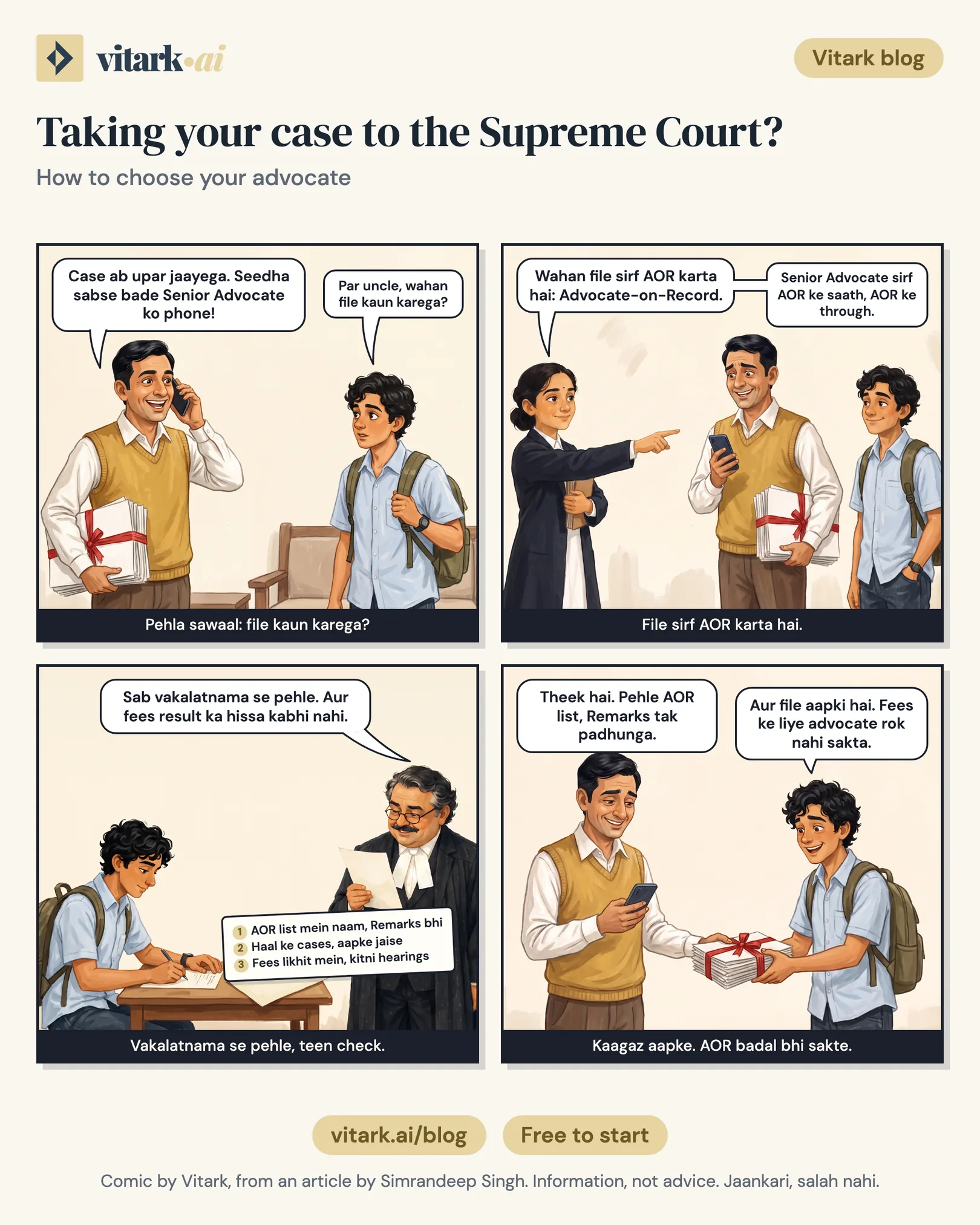
What an advocate's record can and cannot tell you
A record shows where an advocate has appeared and how often. It does not show how good they are, and it is not a ranking. A long list of cases can come from government briefs, or from one large batch of connected cases. Siddh.ai covers the Supreme Court only, starts in 2021, and is built from the text of the Court's orders, so an advocate with a long High Court practice may show little there. Use the record to make a shortlist and to ask better questions. Decide after you have met the advocate.
Cases that matter
Jitender @ Kalla v. State (Govt. of NCT of Delhi), Supreme Court (2025). A petition filed for a prisoner left out the fact that his sentence had been fixed at 30 years without remission. The Court used the case to set out what an AOR must do before filing: read the papers, check the facts, and ask the client or the earlier advocate when something is unclear. When a petition states wrong facts or hides documents, the AOR cannot shift the entire blame. Merely lending a name to a petition is misconduct.
Bar of Indian Lawyers v. D.K. Gandhi PS National Institute of Communicable Diseases, Supreme Court (2024). The national consumer commission had held that a client could bring a consumer complaint against an advocate. The Supreme Court set that view aside: advocates' services fall outside the Consumer Protection Act, 2019. The Advocates Act, 1961 has its own route for complaints of misconduct.
B. Sunitha v. State of Telangana, Supreme Court (2017). After a motor accident claim, an advocate demanded a fee of 16% of the compensation awarded to his client, and filed a cheque bounce case over a cheque said to have been given for it. The Court quashed the case. A fee claimed as a share of what the litigation brings in is professional misconduct, it held, and cannot be the basis of a cheque bounce complaint.
R.D. Saxena v. Balram Prasad Sharma, Supreme Court (2000). An advocate who had acted for a bank refused to hand back its case files until his fees were paid. The Court held that an advocate has no right to hold on to a client's papers for unpaid fees: the files must be returned when the client asks, and the fee claimed separately.
Sources
- Supreme Court Rules, 2013, Order IV (Gazette of India, 29 May 2014): Rule 1 (who may appear and plead), Rule 7(c) (only an AOR may file or act for a party), Rule 2(b) (Senior Advocates), Rule 5 (4 years on the roll, 1 year of training, the examination, and an office within 16 km of the Court), Rule 10 (misconduct, including name lending), Rule 13 (registered clerks), Rule 15 (changing AOR) and Rule 17 (withdrawal for unpaid fees only with the Court's leave). Supreme Court Rules, 2013 (PDF)
- Supreme Court Rules, 2013, Order VIII rule 8 and Third Schedule, Part II, entries 1 to 3 (Part IV categories as substituted on 21 April 2025): ₹1,500 court fee on a special leave petition outside the Part IV categories at filing; Order XX rule 20: no court fee in criminal proceedings. Order XLIX rules 13 and 23 to 27 and the Second Schedule: the schedule of advocates' fees.
- Jitender @ Kalla v. State (Govt. of NCT of Delhi), 2025 INSC 249, paragraphs 21 to 25 and 44; Supreme Court Rules, 2013, Order IV, Rule 10, Explanation (a): the AOR's duty to check what is filed.
- Bar Council of India Rules, Part VI, Chapter II: Section II, Rule 20 (no fee contingent on the result of litigation, and no share of its proceeds) and Section IV, Rule 36 (no soliciting work or advertising).
- Advocates Act, 1961, Section 35 (punishment of advocates for misconduct). India Code
- Supreme Court of India, Advocate-on-Record page, with the search by name and the downloadable list.
- Siddh.ai count of the Supreme Court of India's List of Advocates-on-Record as on 9 October 2026 (4,081 entries, registered from 1954), by the list's own Remarks column: died 273, designated Senior Advocate 227, removed or suspended 86, became a judge or took up another appointment 81. An entry recording more than one change is counted once. Not every change is recorded in the list. List of Advocates-on-Record (PDF)
- Legal Services Authorities Act, 1987, Sections 12 and 13; Supreme Court Legal Services Committee, Entitlement. No court fee on cases filed through the Committee: Supreme Court Rules, 2013, Order VIII, rule 8(1), proviso.
About the author
Simrandeep Singh is the founder of Siddh.ai, which publishes the Supreme Court record of advocates and cases, built from the Court's orders since 2021. Siddh.ai does not rank advocates, and nobody can pay to be counted differently.